Resonance: A Plague Tale Legacy Locations — Venice, Carnival & Minoan Island
The confirmed settings in Resonance: a raiders' camp in the Venice lagoon, 14th-century Venice, and a Minoan island built from real Greek references.
Updated · Official
Resonance runs across two eras and three broad settings, and Asobo’s art director and narrative team laid out the real-world references for all of them in DEVBLOG #3. This page collects what is confirmed about the places you travel through. It is not a route guide — chapter-by-chapter routing belongs on the walkthrough hub when each route has been directly documented.
The two time periods
- Early 14th century — Sophia’s era, roughly 15 years before A Plague Tale: Requiem.
- The Minoan civilisation, around 2000 BC — the ancient half, some 2,000 years earlier.
Asobo call the Minoan period one that “as far as we know, has never really been touched” in games. That is not marketing puff so much as a practical problem they had to solve, and it shapes everything below.
The raiders’ camp in the Venice lagoon
The adventure opens in a plunderers’ camp in the lagoons near Venice — described as rough and poor, but still full of life. Two things about how it was made are worth knowing:
- It was built out from the Red City Arena in Requiem, with worn fabrics and hanging cloth added to make it feel warmer and more lived-in.
- Because 14th-century references for that kind of settlement barely exist, the team looked at working-class districts in Africa and Asia, particularly the wooden structures common at the time.
This is also where DEVBLOG #1 places Sophia’s childhood, in a camp led by her father Alec.
Venice and the carnival
Venice itself is “still largely preserved from that era,” so the architecture was the straightforward part. The hard part was the carnival: huge crowds, and a city that had to feel real rather than idealised.
A carnival sequence with dense crowds is a notable technical commitment for this series, which has historically favoured tight, low-population set pieces punctuated by rat swarms.
The island
The largest chunk of the game happens on the legendary island, hidden somewhere in the Mediterranean. The stated design worry was repetition, and the answer was to pull references from across Greece rather than settling on one look:
| Reference | What it contributes |
|---|---|
| The Cyclades | White limestone cliffs, turquoise water, pine — the baseline look |
| Santorini, Stromboli | Volcanic landscapes, darker rock, an unsettling mood in some levels |
| Thiorichio | More colourful rock formations |
| Preveli Beach | Varied vegetation |
| Knossos, Akrotiri | The Minoan architecture itself |
The compromise they describe is honest about its own invention: they kept core Minoan elements — columns and friezes — then blended in later Greek and Roman influences so the large-scale arenas would read as coherent, because structures at that scale did not exist in the period. Broader references were Assassin’s Creed Odyssey for ancient Greece, and Gladiator and Troy for a more human take on the era.
The result, in their words, is a tension between the restrained, colourful Minoan look and massive, almost excessive arenas — plus familiar Mediterranean scenery set against ominous volcanic terrain.
Artifacts as storytelling
Rather than narrating the island’s history, Asobo decided to let players live it — largely through the artifacts Sophia finds. These are drawn from real Minoan objects and written as pieces of a puzzle she is assembling. Two examples they give:
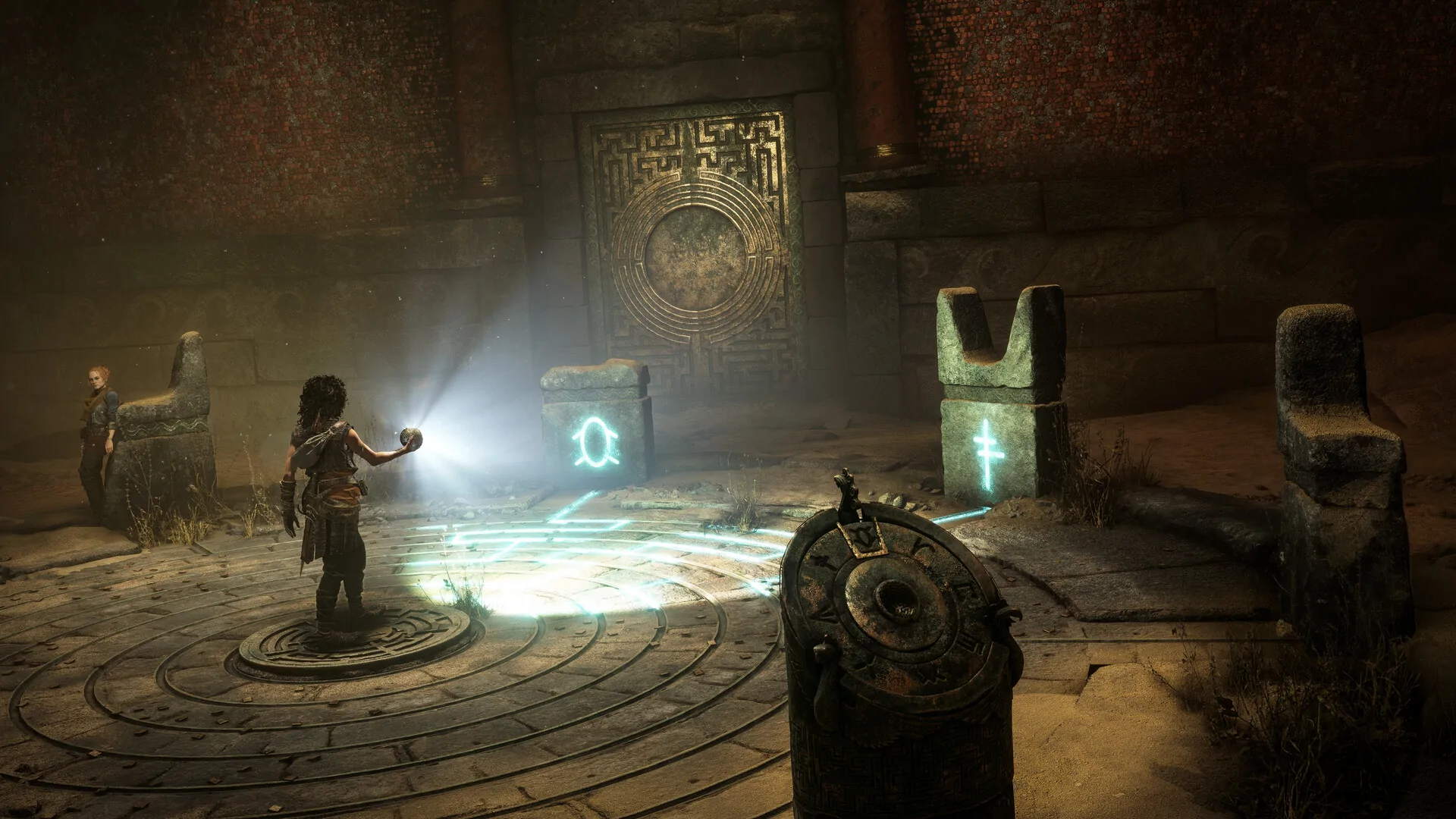
- An orrery — why is a device for predicting the movement of the stars on this island?
- Seal stones depicting people playing with a bull before killing it — a sport, a symbolic trial, or a sacrifice?
Combined with the notebook the store page says guides her, this is where the game’s optional content most likely lives. We track that on the collectibles page.
A note on historical accuracy
Asobo draw a distinction worth repeating: sense of historicity (what keeps you believing you are in the 14th century) versus factual historicity (what is documented). A medieval history associate professor who worked on Requiem advised them again here.
Where the two conflicted, they chose immersion — their example being that both “By cock’s bones!” and “Fie on this world!” are historically attested and would make a player laugh at exactly the wrong moment.
Confirmed vs not confirmed
- Confirmed: the lagoon camp, Venice with a carnival sequence, and the Minoan island; the two eras; artifacts including an orrery and bull-leaping seal stones.
- Not confirmed: chapter count, chapter order, how much of the island is open, and whether the Venice sections are early-game only.
Sources and verification
Fact sources
| Status | Source | Used for | Checked |
|---|---|---|---|
| Official | Official Steam devblogs and FAQAsobo Studio / Focus Entertainment | First-party posts on the Steam news hub for App 2713000: the Resonance FAQ (platforms: "PC, Xbox Series X|S and PS5"), plus DEVBLOG #1 Sophia’s Story, #2 Anna Demetriou interview, #3 "Into The Myth", #4 Olivier Derivière interview. | |
| Steam feature | Steam store pageValve / Steam | App id 2713000, developer, publisher, release date, price, genres, categories, languages, screenshots, and the official Steam description. | |
| Official media | Steam official media galleryValve / Steam | Official screenshots, header art, and trailers published on the Steam store page. |